Biography
About
A life strung between Lucknow and the world
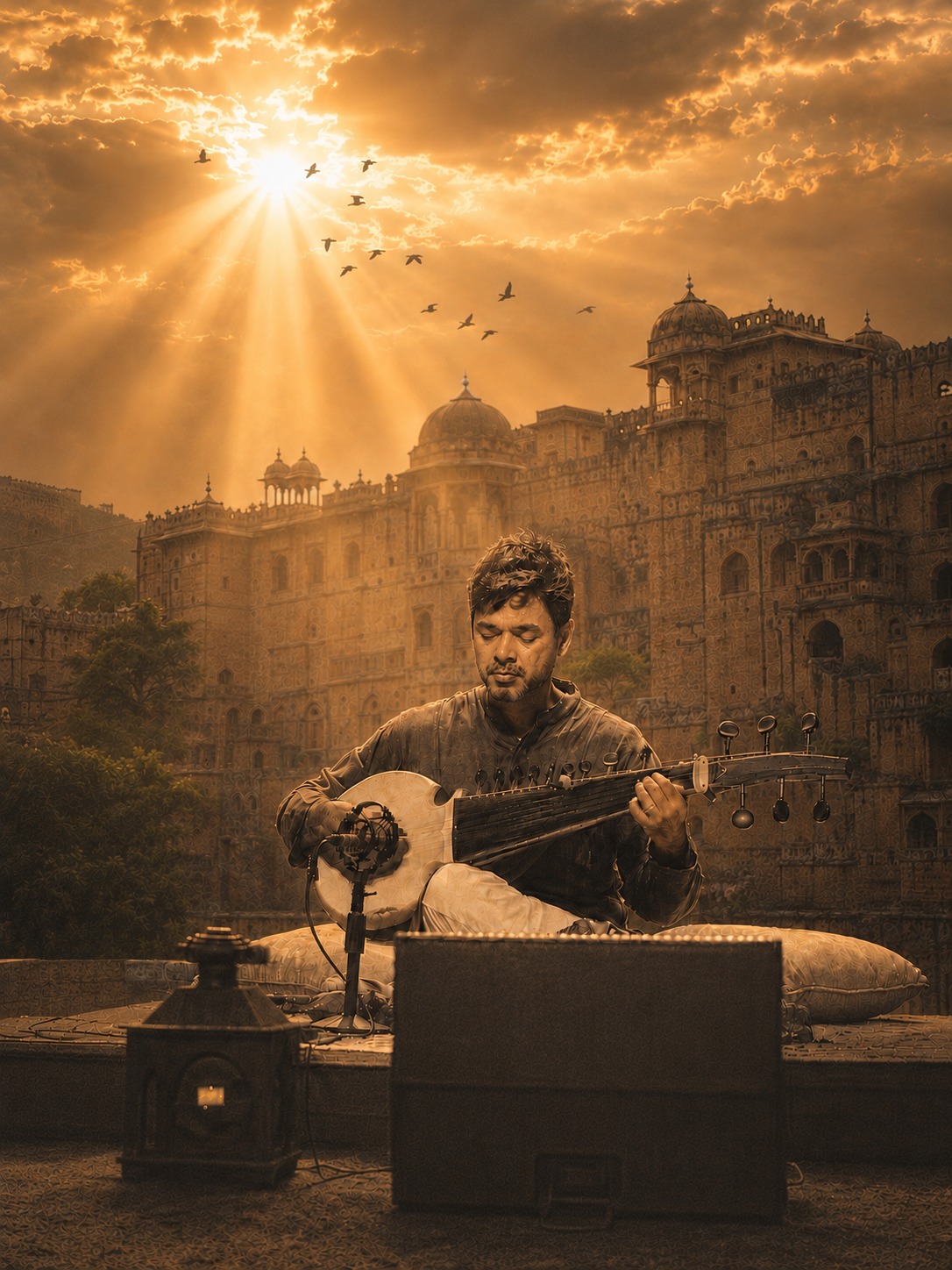
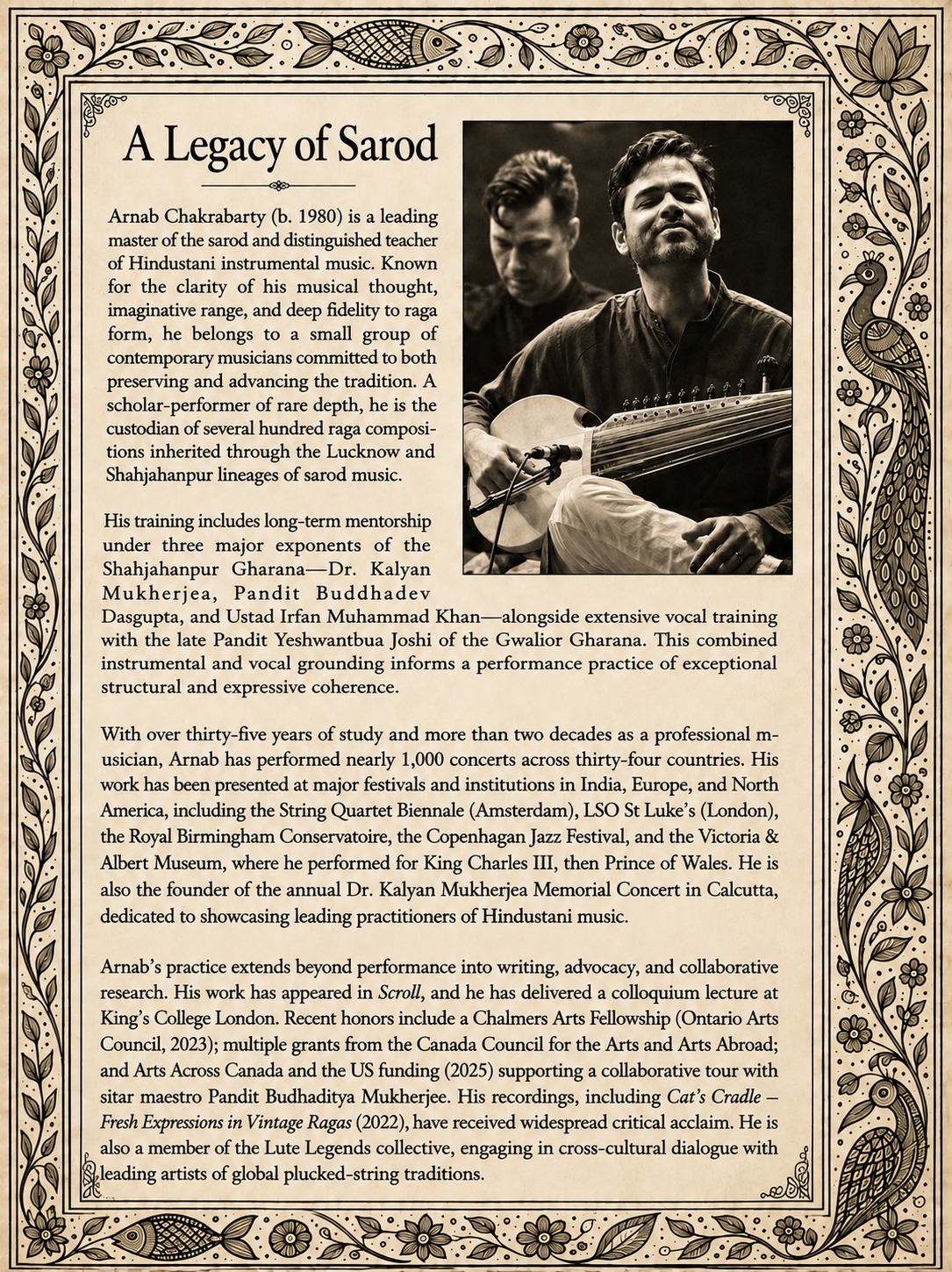
Artist Profile
Narrative Biography
Arnab Chakrabarty is a masterful sarod player whose work transcends the established idioms of Hindustani instrumental music, borrowing deeply from khayal and dhrupad vocal styles. His width of stylistic influences draws not only from immediate, filtered pedagogy, but vast listening and internalisation of the living memory of the early recorded era of both contemporary and extinct musical idioms. It is this width and depth of immersion that make Chakrabarty arguably among the most distinctive instrumentalists in Hindustani music today.
Grounded in decades of intense, traditional apprenticeship under Prof. Kalyan Mukherjea, Ustad Irfan Muhammad Khan, and Pandit Buddhadev Dasgupta, his musicianship represents a rigorous and erudite lineage. Arnab is, in fact, the only musician to have been trained comprehensively in both the Lucknow and Bengal branches of the Shahjahanpur Gharana.
Rather than deploying technique as an end in itself, Chakrabarty’s work intentionally subjugates phenomenal instrumental facility to the higher demands of the music. His performances treat the traditional bandish as a live ideational blueprint—demanding real-time compositional risk, intricate rhythmic control, and an exhaustive command of both foundational and rare ragas.
Since his professional debut in 1996, Chakrabarty has delivered over 1,000 public performances across 35 countries. His concert history includes an unprecedented 10-concert North American tour of double-bill performances alongside sitar maestro Pandit Budhaditya Mukherjee, alongside appearances at major institutions such as the Victoria and Albert Museum (London), LSO St Luke’s, the National Centre for the Performing Arts (Mumbai), and the 2024 String Quartet Biennale Amsterdam. These appearances are marked by long-standing stage partnerships with prominent rhythm practitioners, including tabla masters Shahbaz Hussain and Sukhvinder Singh Namdhari.
Chakrabarty’s intellectual and artistic domain extends naturally into scholarship, instrument design, and public writing. A graduate of Hampshire College, his practice bridges performance with organology and critical inquiry into oral traditions. Supported by the Chalmers Arts Fellowship (2023-24) from the Ontario Arts Council and multiple grant awards from the Canada Council for the Arts, his work examines real-time composition, historical performance practice, and instrument design.
Refusing to treat the sarod as a static artefact, Chakrabarty brings a hands-on organological precision to his craft. He continuously modifies, adjusts, and custom-designs his instruments, tailoring their acoustic response, neck profiles, and fingerboard geometry to meet the exacting physical demands of his music. The result is a performance style stripped of sentimental nostalgia: direct, technically formidable, and fiercely authentic.
Apprenticeship
Training & Lineage
Grounded in decades of intense, traditional apprenticeship under Prof. Kalyan Mukherjea, Pandit Buddhadev Dasgupta and Ustad Irfan Muhammad Khan, Arnab is the only musician to have been trained comprehensively in both the Lucknow and Bengal branches of the Shahjahanpur Gharana.
- Prof. Kalyan MukherjeaBengal branch
- Pandit Buddhadev DasguptaBengal branch
- Ustad Irfan Muhammad KhanLucknow branch
Education
Educational Background
A graduate of Hampshire College, Arnab Chakrabarty’s practice bridges performance with organology and critical inquiry into oral traditions.
Alongside his instrumental apprenticeship, he undertook extensive vocal training under the late Pandit Yeshwantbua Joshi of the Gwalior Gharana.
Ledger
Institutional Affiliations & Grants
Fellowships & grants
- Fellowship · 2023–24Chalmers Arts FellowshipOntario Arts Council
- GrantsMultiple grant awardsCanada Council for the Arts
- GrantArts Abroad
- Funding · 2025Arts Across Canada and USSupporting a collaborative tour with sitar maestro Pandit Budhaditya Mukherjee
Affiliations, writing & lectures
- CollectiveLute LegendsMember of the collective
- PublicationScrollWriting published in Scroll
- LectureKing’s College LondonColloquium lecture
- FounderDr. Kalyan Mukherjea Memorial ConcertAnnual, Calcutta · see Outreach
Organology
Instrument Design
The sarod is not an ancient relic, but a modern instrument. It emerged in the early 19th century through an encounter between regional craft and incoming technology. Born from the synthesis of the Afghan rabab and the Indian sursringar, it retains the carved wooden body and parchment soundboard of the former, but adopts the mirror-finished fretless steel fingerboard and metal strings of the latter.
Acoustic Profile and Design Evolution
The acoustic profile of the sarod balances percussive attack with sustained singing. Sound originates from a plectrum (java) striking metal strings. It transfers through a wooden bridge resting on a skin-headed soundboard. Notes are stopped not with the finger pads, but by pressing or sliding the edge of the fingernail against polished steel.
Because a plucked string decays quickly, 19th-century players relied on rapid stroke work and dense rhythmic patterns. Over time, luthiers and musicians modified fingerboard relief, neck taper, and action height. These adjustments lengthened string sustain, giving the instrument a vocalized expression (gayaki ang) capable of fluid, multi-note glides (meend).
Modern refinements, such as planetary geared tuning pegs and modified upper barrels, give today’s instruments precise tuning and easy access to the highest octave.
| Structural Element | Historical Antecedent (Afghan Rabab) | Modern Sarod |
|---|---|---|
| Fingerboard | Wood | Polished Stainless Steel |
| Strings | Gut / Silk | Steel & Bronze |
| Stopping Technique | Pressing with finger pads | Sliding with fingernail edges |
| Sound Envelope | Short decay, percussive | Extended sustain, vocalized (gayaki) |