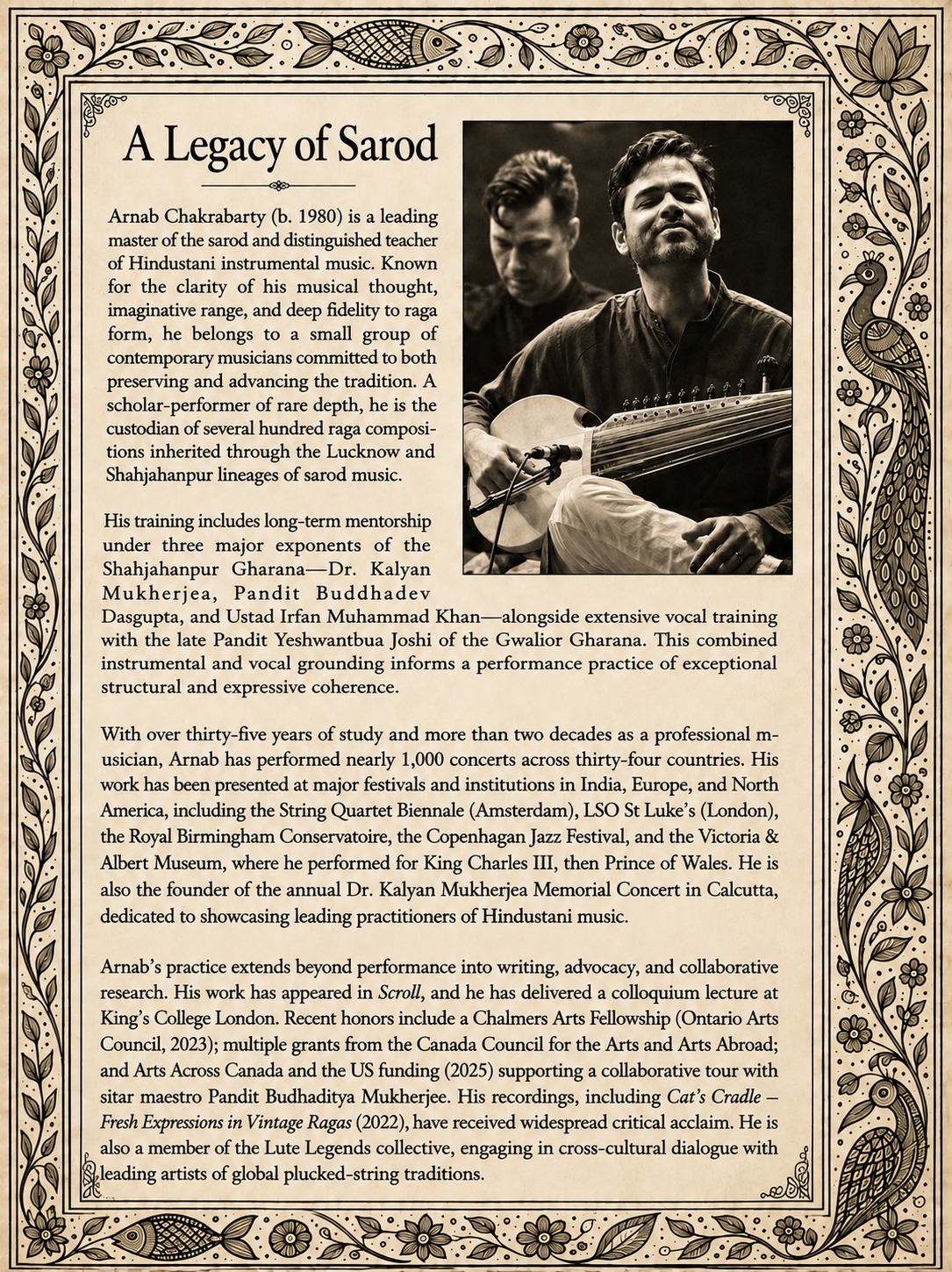
Electronic press kit

Press

Photographs, biographies, rider and recordings, for presenters and the press

From the notices

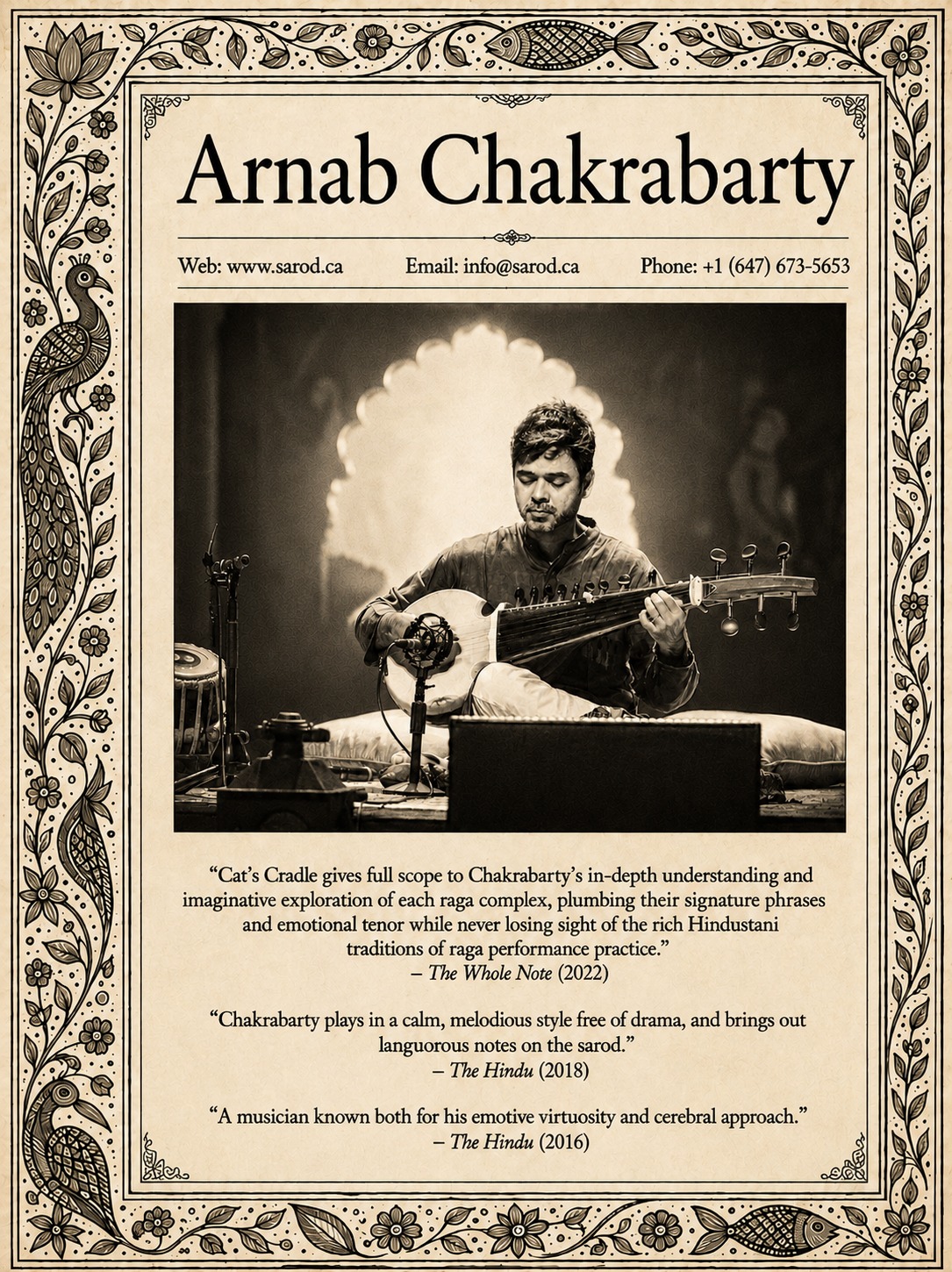
Cat’s Cradle gives full scope to Chakrabarty’s in-depth understanding and imaginative exploration of each raga complex, plumbing their signature phrases and emotional tenor while never losing sight of the rich Hindustani traditions of raga performance practice.

The Whole Note, 2022

Chakrabarty plays in a calm, melodious style free of drama, and brings out languorous notes on the sarod.

The Hindu, 2018

A musician known both for his emotive virtuosity and cerebral approach.

The Hindu, 2016

Hi-resolution photographs

Photographs

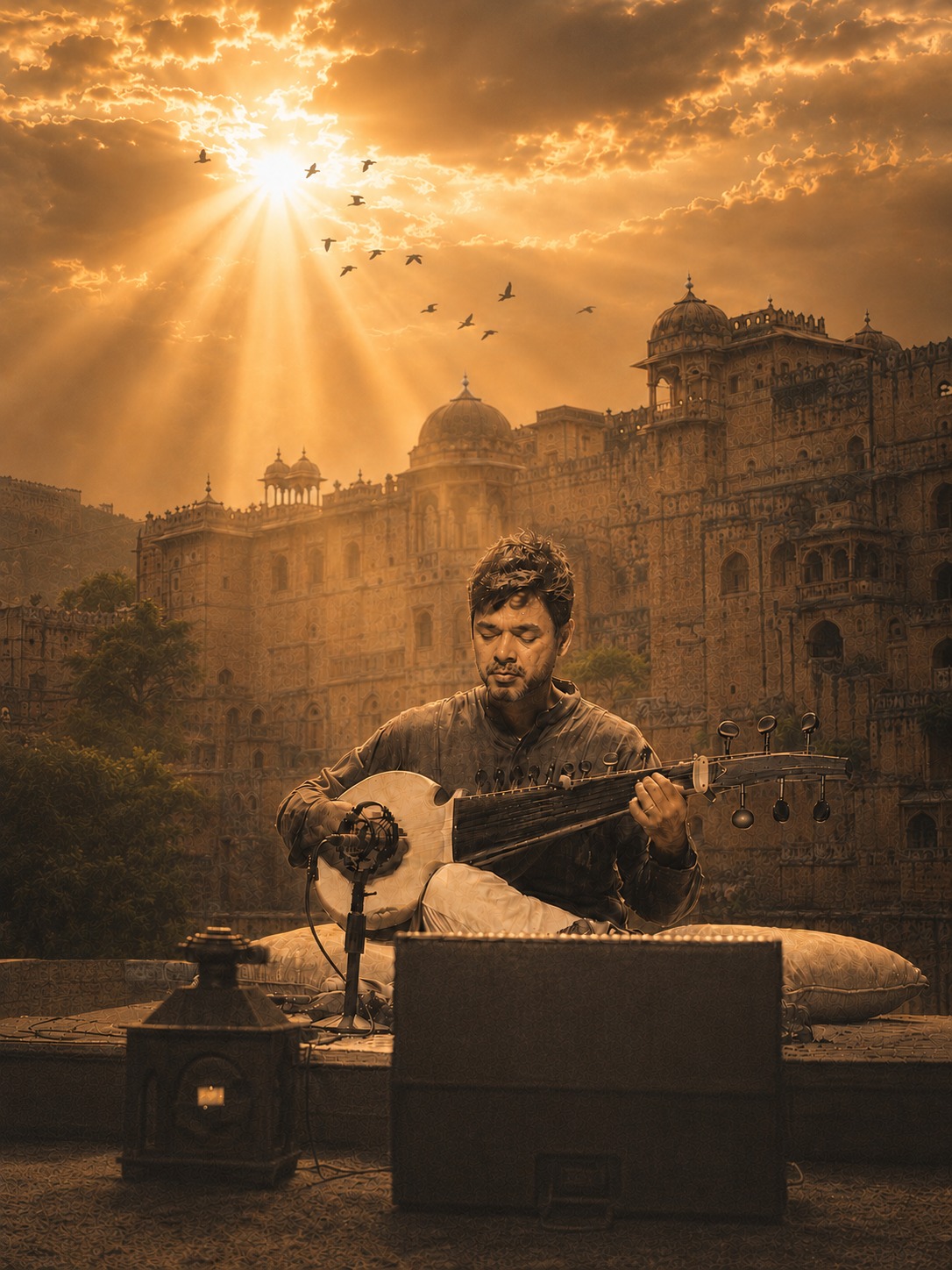
Cleared for editorial and promotional use in connection with Arnab Chakrabarty’s performances. Please credit as supplied, and do not crop through the instrument.

Biographies

Biographies

Either text may be printed as it stands. Please do not edit without consent; write to info@sarod.ca for a variant length.

Short biography (about 100 words)

Arnab Chakrabarty is a sarod player whose work transcends the established idioms of Hindustani instrumental music, borrowing deeply from khayal and dhrupad vocal styles. Grounded in decades of traditional apprenticeship under Prof. Kalyan Mukherjea, Ustad Irfan Muhammad Khan and Pandit Buddhadev Dasgupta, he is the only musician to have been trained comprehensively in both the Lucknow and Bengal branches of the Shahjahanpur Gharana. His performances treat the traditional bandish as a live ideational blueprint. Since his professional debut in 1996, he has delivered over 1,000 public performances across 35 countries, with support from the Ontario Arts Council and the Canada Council for the Arts.

Narrative biography

Arnab Chakrabarty is a masterful sarod player whose work transcends the established idioms of Hindustani instrumental music, borrowing deeply from khayal and dhrupad vocal styles. His width of stylistic influences draws not only from immediate, filtered pedagogy, but vast listening and internalisation of the living memory of the early recorded era of both contemporary and extinct musical idioms. It is this width and depth of immersion that make Chakrabarty arguably among the most distinctive instrumentalists in Hindustani music today.

Grounded in decades of intense, traditional apprenticeship under Prof. Kalyan Mukherjea, Ustad Irfan Muhammad Khan, and Pandit Buddhadev Dasgupta, his musicianship represents a rigorous and erudite lineage. Arnab is, in fact, the only musician to have been trained comprehensively in both the Lucknow and Bengal branches of the Shahjahanpur Gharana.

Rather than deploying technique as an end in itself, Chakrabarty’s work intentionally subjugates phenomenal instrumental facility to the higher demands of the music. His performances treat the traditional bandish as a live ideational blueprint—demanding real-time compositional risk, intricate rhythmic control, and an exhaustive command of both foundational and rare ragas.

Since his professional debut in 1996, Chakrabarty has delivered over 1,000 public performances across 35 countries. His concert history includes an unprecedented 10-concert North American tour of double-bill performances alongside sitar maestro Pandit Budhaditya Mukherjee, alongside appearances at major institutions such as the Victoria and Albert Museum (London), LSO St Luke’s, the National Centre for the Performing Arts (Mumbai), and the 2024 String Quartet Biennale Amsterdam. These appearances are marked by long-standing stage partnerships with prominent rhythm practitioners, including tabla masters Shahbaz Hussain and Sukhvinder Singh Namdhari.

Chakrabarty’s intellectual and artistic domain extends naturally into scholarship, instrument design, and public writing. A graduate of Hampshire College, his practice bridges performance with organology and critical inquiry into oral traditions. Supported by the Chalmers Arts Fellowship (2023-24) from the Ontario Arts Council and multiple grant awards from the Canada Council for the Arts, his work examines real-time composition, historical performance practice, and instrument design.

Refusing to treat the sarod as a static artefact, Chakrabarty brings a hands-on organological precision to his craft. He continuously modifies, adjusts, and custom-designs his instruments, tailoring their acoustic response, neck profiles, and fingerboard geometry to meet the exacting physical demands of his music. The result is a performance style stripped of sentimental nostalgia: direct, technically formidable, and fiercely authentic.
For presenters and sound engineers

Technical rider

Standard rider; confirm per venue

A recital of sarod with tabla. The requirements below are the usual starting point; halls, house systems and acoustics differ, and particulars are settled with the presenter in advance of each engagement.

Performers
Two: sarod and tabla. A tanpura drone, where used, is supplied by the artist.
Stage
Raised platform, carpeted, roughly 2.4 × 2.4 m (8 × 8 ft), stable and free of resonance.
Seating
Floor seating on the platform, with cushions or bolsters for both performers. No chairs.
Sarod
Two condenser microphones on short boom stands.
Tabla
Two condenser microphones, one for each drum.
Monitoring
One floor monitor, shared, with separate sarod and tabla sends where the desk allows.
Soundcheck
Sixty minutes in the hall, before doors.
Tuning
Thirty minutes, in a quiet room or on stage, immediately before the performance.
Lighting
Warm, even wash; no strobes or moving lights.

A fuller rider, with input list and stage plot, is available on request from info@sarod.ca.

Marks

Logos

Wordmark and emblem, in vector form, for posters and programmes.

Recorded performances

Performances on YouTube

Three recordings, each with the composer of the gat and the tabla accompanist named, as is proper.

Interviews, review copies, accreditation

Press contact

info@sarod.ca

For bookings, see Contact.